
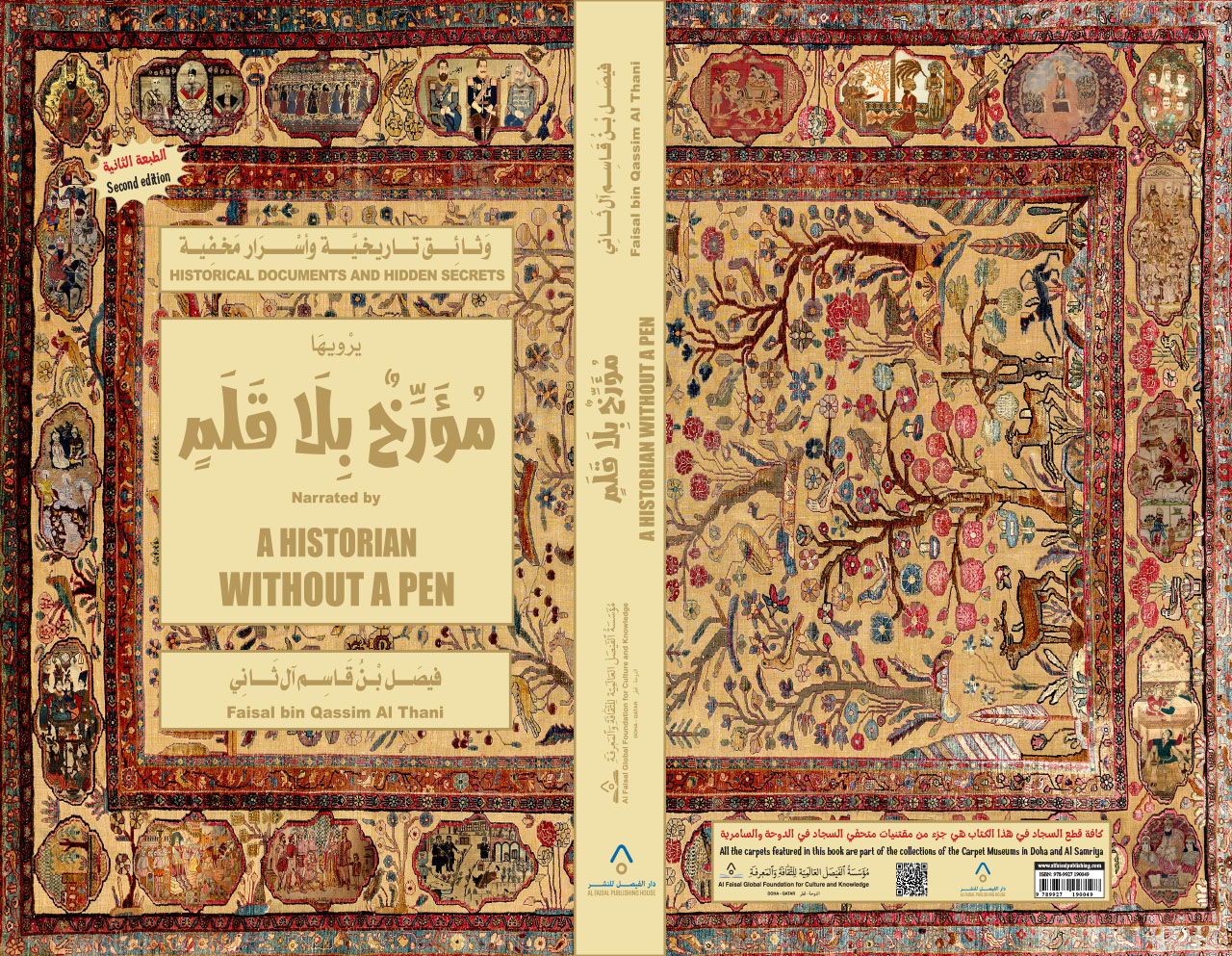
DOHA – April 30, 2026: The release of the second edition of the book “A Historian Without a Pen: Historical Documents and Hidden Secrets” by H.E. Sheikh Faisal bin Qassim Al Thani—published by Al-Faisal Global Foundation for Culture and Knowledge in collaboration with Al-Faisal Publishing—received widespread media coverage across various Qatari newspapers and media outlets. This media recognition reflects the importance of the book as a visual witness that reads human history from an unconventional perspective; where knots, patterns, and heritage motifs transform into living documents and recorded archives that give voice to what history kept silent, documenting the secrets of nations and peoples prior to the advent of cameras and modern media.
Al-Sharq: Recounting What History Kept Silent
Al-Sharq newspaper highlighted the significance of this release as a distinct narrative project that re-evaluates how history is read—not through the lens of dry facts, but through the implicit signals and unspoken meanings hidden within historical documents.
The newspaper added that through historical documents and hidden secrets, the reader is introduced to historical material presented with an investigative spirit, where storytelling intertwines with analysis, and the documented sits alongside the imagined within a single space. The book restores value to small details that are often overlooked in major narratives, making it a work that does not merely display the past, but re-tells it while uncovering its deepest layers.
It further noted that through a balancing style of precision and wonder, the author offers a reading akin to a journey into the corridors of human memory, where the document becomes a witness that hints and invites the reader to ponder rather than revealing every detail outright.
Al-Raya: When Patterns Turn into the Memory of Nations
In its analysis of the book, Al-Raya newspaper stated that the work presents an unconventional approach to the concept of history, moving away from recounting events as static occurrences toward a deeper reading based on deconstructing documents and reflecting on the subtle meanings and implicit signals between the lines.
It noted that the book transforms into a space of transit across eras, where the past is no longer merely display material, but an open field for reinterpretation. The reader becomes an active partner in producing meaning rather than a passive recipient, in an experience aimed at redefining the relationship between humans and history as an ongoing pursuit that does not end at the boundaries of the text.
Al-Raya concluded that the author does not present the book on carpets merely as an aesthetic or heritage element, but as a knowledge medium carrying the memory of peoples within its patterns and threads. It retells history from a different perspective where craftsmanship intersects with politics, symbol with event, and individual memory with collective memory.
Al-Watan: Narrating the History of Nations and Peoples
For its part, Al-Watan newspaper stated that the book provides the audience with visual documentation alongside a narrative account of profound historical memories. It addresses nations, explores peoples, and chronicles the biographies of leaders and rulers, without overlooking tales of myths and wars, as well as the civilization transformations the world witnessed over hundreds of years. This endows the publication with uniqueness and distinction by offering an alternative reading of many chapters of history through heritage carpets as living documents that predated many modern means of documentation.
The newspaper added that the historian appears as a voice narrating from outside traditional tools—like “a historian without a pen”—writing beyond words to reshape the relationship between the reader and history into one of discovery and inquiry, rather than passive reception or resignation.